2011-2012
[Please scroll all the way down for chronological developments of the year]
Over the course of nine months, Proteus Gowanus considered “Migration” and the frequently unanticipated effects that flow from it, using art, artifacts, books and events as the tools of our investigation. We considered animal, human and object migration and the ways in which they interact, interrupt and intercede with each other. Our final exhibition Future Migration examined how these movements are affecting our future on the planet, bringing crisis and calamity aplenty, but also exponential knowledge expansion, increasing porosity of boundaries, more and better communication of ideas and, dare we say it? Greater empathy.
Our first exhibition opened in September, second in January and third in April. We concluded the year with an exhibition of work by our Migration Artists-In-Residence.
The Migration Artists-In-Residence program, inviting a new artist for each of the year’s three Migration exhibitions to work at Proteus, was a new project at Proteus Gowanus. We invited artists to open their process and engage with visitors. Our artists, in order of their residency, were Lado Pochkhua of the Republic of Georgia, Sal Randolph, and anthropologist Eben Kirksey, in collaboration with the Multi-species Salon.
We also introduced a blog for the Migration year, named Proteoscope. Krista Dragomer, artist, writer, and graphic essayist, will be Proteoscope’s Editor-in-Chief, who collected, reported and mused on the art, artifacts, books and events presented during our Migration year.
Finally, we welcomed as Migration Correspondents, the following distinguished individuals: Carol Becker (Dean of Columbia School of the Arts); Svetlana Boym (Curt Hugo Reisinger Professor of Slavic and Comparative Literatures at Harvard University and a Faculty Associate of the Graduate School of Design); and Sean Hanley, filmmaker. Our Migration interns were Allison Klion, Sophia Karwowski, Caridad Bojorquez and Ryan Jones.
Exhibition 1: Population Migration
Fall, 2011 (Sept 17-Jan 7)
Migration as a term can apply to almost anything that moves but in general the term brings to mind the movement of humans and animals across geographic terrain. This is the starting point for this first exhibition of the Migration year at Proteus Gowanus.
Contributors: Aileen Bassis, Meredith Bergmann, The Brooklyn Museum Libraries and Archives, Lola Bunting, Marie Cieri, Viv Corringham, Andrew Garn, Dillon de Give, Nene Humphrey, Sarah Lederman, Portia Munson, the Museum of Matches, Lance Rutledge, Randall Stoltzfus, Lorena Turner, James Walsh and, in partnership with Reanimation Library, Ami Yamasaki.Exhibition 2: Object Migration
Winter, 2012 (Jan 12-April 7)
A. Object Migration
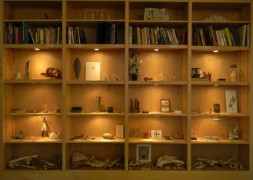
When we think about migration, we tend to focus on people and creatures, the mobile inhabitants of the planet. But life and motion create products and byproducts: tools, waste, the material manifestations of culture. These things are often what drive us onward in our migrations. We asked our community of friends and collaborators and all others to contribute objects with migratory stories for this show. With over 50 contributors, objects on display range from a 50 million year old “dinosaur fart” (or gas bubble) to a collection of wild bird’s stomach contents collected in the early 20th C for “scientific” purposes. There are also talismans, mundane objects with secret meanings, things of beauty and much more.
We view these objects as independent beings with stories of their own, stories that began before the object’s encounter with its current owner and that will likely continue long after they part. The stories may migrate into the economic, the industrial, the political, the historical, the geologic, the environmental and so on as visitors add to the stories on display with information they may have about the object in question.
Object Migrations was presented by Proteus Gowanus with curatorial assistance from the artist Sal Randolph, creator of the Free Biennale, Free Manifesta, Free Words and Manifesta, and from Smudge Studio, creator of the book Geologic City: A Field Guide to the GeoArchitecture of New York, exploring the convergence of the geologic and the human, and of Friends of the Pleistocene. Sal will also be our Artist-In-Residence for the duration of the Objects Show. We also wish to thank Twig Terraria, on 4th Ave and President, for assisting us with our display by providing glass terraria.B. The Bureau of Unknown Destinations
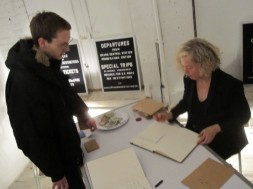
As part of Object Migrations, we introduced The Bureau of Unknown Destinations, offering temporary displacements to members of the public seeking to experiment with their migratory impulses.
The Bureau of Unknown Destinations is part of a three month artist’s residency by Sal Randolph at Proteus Gowanus, extending through mid-April.C. The Berlin Tunnel Project
(Jan 28-Feb 25)
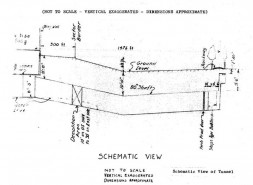
In 1954, the CIA began to dig a tunnel from West Berlin to East Berlin for the purposes of tapping into Soviet phone cables. The tunnel’s construction took a year and, unbeknownst to the CIA was monitored throughout by the KGB. In April 1956, the KGB “discovered” the tunnel and released the information to the world press. American newspapers generally marveled that the CIA was capable of such a remarkable clandestine maneuver.
The Berlin Tunnel Project was a collaborative installation by three artists whose countries of origin comprise the three countries involved in the Berlin Tunnel episode: Tatiana Istomina (Soviet Union), Barbara Westermann (Germany) and Sasha Chavchavadze (United States).Exhibition 3: Future Migration
Spring, 2012 (Apr 14 - Jul 1)
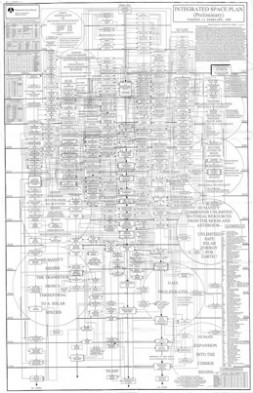
For the third exhibition of the Migration year, Proteus Gowanus presents FUTURE MIGRATION, an exploration of the possibilities and predicaments of life in the anthropocene future. What sorts of resources will be preserved or invented to allow life on this planet to continue? Will Earth always be home or will we look out into the galaxy to find new and alternative solutions in the stars? Will we continue to exist as natural beings or will our technologies lead us to a new definition of what it means to be human.
FUTURE MIGRATION brings together artists, scientists, and visionaries in an exhibition of art, artifacts, and books, as well as talks, film and other events that explore future directions, continuing our migratory investigations into July. Co-curated with artist Krista Dragomer.
Contributors: Indrani Ashe, Scott Billings, Kevin Clement, Elizabeth Cope, Donald Daedalus, Eymund Diegel, Krista Dragomer and Rashin Fahandej, Sarah Edkins, David Eustace, Peter Fend, Rebecca Heritage, Rita London, Beatrice Marovich, Elisabeth Pellathy, Eric Pettiti, Deanna Pindell, Barbara Rosenthal, Debra Tillinger, Emily Tobey, Barbara Westermann, Bryan Wilson, Sen-I Yu.Concurrently, for our third residency of the Migration year, we are delighted to welcome Anthropologist-In-Residence, Eben Kirksey and his collaborators with the Multi-Species Salon. They will work in text, conversation and installation. Eben will display his “Utopia for the Golden Frog” (co-produced by Mike Khadavi & Grayson Earle). The Golden Frog is a species critically endangered by humans and saved by the Amphibian Ark. Deanna Pindell’s ‘Thneeds Re-Seed”, a sculptural remediation strategy with Bryum Argenteum moss, will also enliven the Salon. Our Anthropologist will examine human entanglement with plants, microbes, and animals and develop art/projects intended to help us think about living with and in a multispecies world. His particular emphasis will be on finding Hope in Blasted Landscapes.
In addition, as part of Future Migration, we welcome THE FOOL’S JOURNEY, a corollary exhibition on our shelves curated by our friends from Curious Matter in Jersey City, NJ. In the Tarot, The Fool symbolizes the beginning of a journey. He sets off to explore without knowing what lies ahead. He isn’t a fool in the sense of a buffoon, rather one who proceeds on an adventure in spite of his lack of experience. To confront the unknown; the accumulation of knowledge; transformation from ignorance to wisdom; moving from one place to another, whether physical or psychical, are aspects of The Fool’s Journey.
Migration Events
September 2011- JULY 2012
Opening Reception for Migration
Saturday, September 17, 7pm
Rise and Fall: Nautical Art on the Gowanus
Art in Odd Places, in partnership with the Institute for Urban Design and Proteus Gowanus, presented a panel discussion on artists and activists who take the NYC waterways as their creative point of departure, and who have crafted alternative ways to reclaim the water as viable public space for the first annual Urban Design Week festival (September 15 – 20, 2011). Tuesday, September 20, 2011 [more]
Ami Yamasaki and friends: 3 performances
Yamasaki, a vocalist and multidisciplinary artist from Tokyo, Japan, presented ENERGY, (bird) bird, and sound and movement. Thursday, September 29, 2011 [more]
Evening of Appropriation and Experimental Animation, with short films by Lillian Schwartz, Toshio Matsumoto, Steve Cossman, LJ Frezza, Douglas Goodwin & Rebecca Baron. Tuesday, November 1, 2011 [more]
An Artist Conversation with Duke Riley
Presented in conjunction with Portland State University’s Art and Social Practice MFA Lecture Series. Duke Riley is an artist whose work addresses the prospect of residual but forgotten unclaimed frontiers. Monday, November 14, 2011 [more]
In the second evening of our Migration Film series, a series of short documentaries will reveal the travels of our feathered friends and aquatic allies. Tuesday, December 6, 2011 [more]
The Bureau of Unknown Destinations
Offered temporary displacements to members of the public seeking to experiment with their migratory impulses, starting January 12, 2012. [more]
Opening Reception: Object Migration
Over 50 objects and their migratory stories brought to us by you, our friends and collaborators. Some objects speak of intensely intimate moments while others tell geologic tales of perfect indifference. Thursday, January 12,2012 [more]
Leslie-Arlette Boyce, lead author of The Glory of Brooklyn’s Gowanus: Legacy, Industry, and Artistry. Boyce will discussed her book, its images and local history from the arrival of the Dutch West India Company to the present day. Joined by Chris Matias, founder and director of the Redhawk Native American Arts Council, who discussed the continuing presence of Native Americans in the Gowanus area. Saturday, January 21, 2012 [more]
Opening Reception: The Berlin Tunnel Project
An installation inspired by a declassified CIA document describing a tunnel that was dug from West to East Berlin during the Cold War. Saturday, January 28, 2012 [more]
Music Migration: Films of Iran
An evening of films about forced relocation of populations in Iran and its impact on the music of the region. Tuesday, February 7, 2012 [more]
The Wayfarers: Films on Solitary Migration
Filmmakers Bill Brown, Vanessa Renwick, and Kevin Gallagher each undertook solo journeys across vast distances within the United States. The films they made documenting their experiences shows an American landscape that has changed dramatically, both physically and culturally, over the past decade. Tuesday, March 6, 2012 [more]
Where does a journey begin? And how do we know where it ends?Dr. Debra Tillinger explores the art of mapping, from the times of ancient seafarers to the present day. Saturday, March 10, 2012 [more]
Walk to Commemorate Hal the Coyote’s Urban Migration
In 2006 an intrepid trickster appeared in Central Park. Hal the coyote, named after the Hallet Sanctuary where he was discovered, attracted a blitz of local news coverage before he was captured. He then died unexpectedly upon being released north of the city. Since 2009 Dillon de Give has made annual voyages on foot, both alone and with others, on the anniversary of the animal’s death in early April. Saturday, March 24, 2012 [more]
Object Lessons is a one-evening series of tiny lectures based on the objects from the current Proteus exhibition, Object Migration. Friday, March 30, 2012 [more]
The Bureau of Unknown Destinations will be having a small celebration for all the adventurous souls who have traveled to unknown destinations over the past months. Saturday, March 31, 2012 [more]
Milgration Film : Immokalee U.S.A.
Documentary film by Georg Koszulinski. Every season, tens of thousands of migrant farmworkers converge on small communities like Immokalee, Florida where they plant and harvest the food that Americans consume. Tuesday, April 3, 2012 [more]
Music, Migration and the Maghreb
A lecture with recordings and discussion of a great era of Jewish-Muslim musical collaboration in North Africa and beyond. Thursday, April 5, 2012 [more]
Multispecies Salon Conversation Series
Conversation #1: The Multispecies Salon: Gleanings from a Para-Site Sunday, April 29, 2012 [more]
A silent walk through the woods with urban nature blogger and bird-listener Matthew Wills Sunday, April 29, 2012 [more]
Opening Reception for Future Migration
An exploration of the possibilities and predicaments of life in the anthropocene future. Saturday, April 14, 2012 [more]
The Urban Geological Study will lead participants on a hands-on exploration in the neighborhood to gather materials, identify, classify, and tell a new story of objects found in the local urban environment. Sunday, April 15, 2012 [more]
Party for New Proteotypes Book by James Walsh
James Walsh, a longtime friend of Proteus Gowanus as well as a founder/collaborator of Observatory, has just brought out his latest book, There was Something in the Weather, in the Libellulæ series published by Proteotypes, our print arm. Friday, April 20, 2012 [more]
New York City Coyote Existential: A Play
A reading of a new short play with songs and science by Melissa Cooper. Music by Thomas Cabaniss. Saturday, April 21, 2012 [more]
Your Day Is My Night: An Interactive Film-Performance
Brooklyn-based filmmaker, Lynne Sachs, brought us a specially designed evening of film and integrated movement pieces based on her recent work with a group of Chinese and Puerto Rican performers. Tuesday, May 1, 2012 [more]
Multispecies Salon host, anthropologist Eben Kirksey, second in our three-part discussion series exploring what happens when the natural and the human-generated meet. Sunday, May 6, 2012 [more]
People Who Talk With Birds: Siberian Shamans
Join anthropologist Thomas R. Miller in a multimedia experience, “People Who Talk With Birds: Siberian Shamans in the Future Past.” Saturday, May 19, 2012 [more]